Landscaping guide · Mesa, AZ
Mesa Landscaping Guide: Costs, Water, Soil, Plants and Rules
Landscaping for a Mesa yard you will actually use, planned for caliche, hard water and July heat. New installs, artificial turf, pavers and walls, sprinkler repair and grass to desert conversions, with published price ranges and the city rebate that pays up to $2,100.
Service area
What does landscaping cover in Mesa?
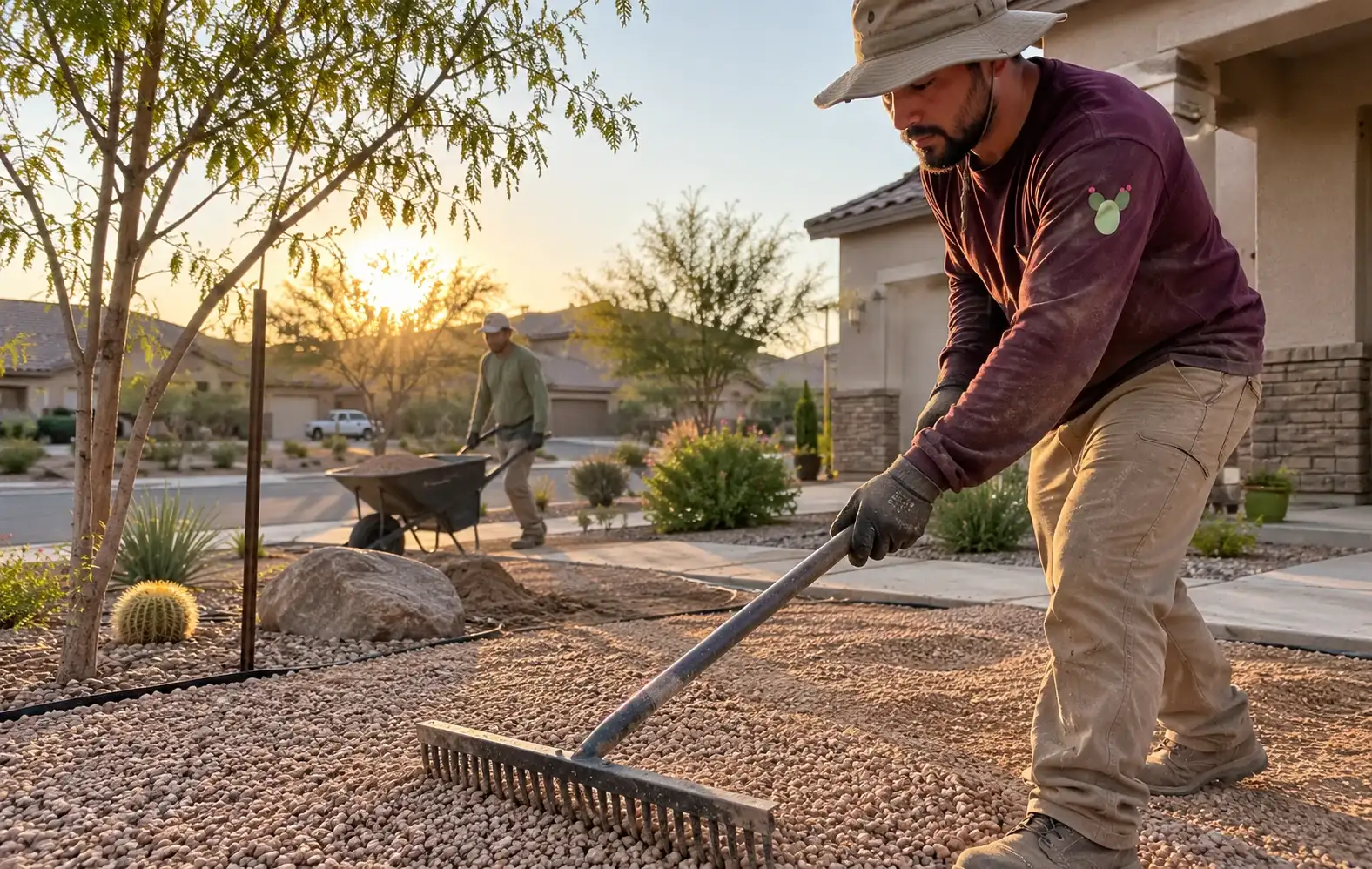
Landscaping covers everything outside the walls of the house: grading, irrigation, plants, hardscape and any turf. In Mesa that is 5 linked decisions, and they have to be made together because changing one moves the others. Grading sets where water runs. Irrigation decides whether plants survive July. Plant choice follows USDA zone 9b, which covers most of Mesa, with an average annual extreme minimum of 25 to 30 F. Hardscape covers patios, walkways, walls and shade. Turf, real or artificial, covers the part you want to walk on barefoot.
A yard that fails has often failed at the join between 2 of those. Turf laid on a slope that drains toward the house. Plants picked for a wetter climate, dropped onto drip lines sized for nothing. The 5 parts can be priced separately, so what each one costs is visible before committing to all of them.
Services
Which of the 5 landscaping services does your yard need?
Many Mesa yards need more than 1 of these 5 kinds of landscaping work:
Landscape Installation
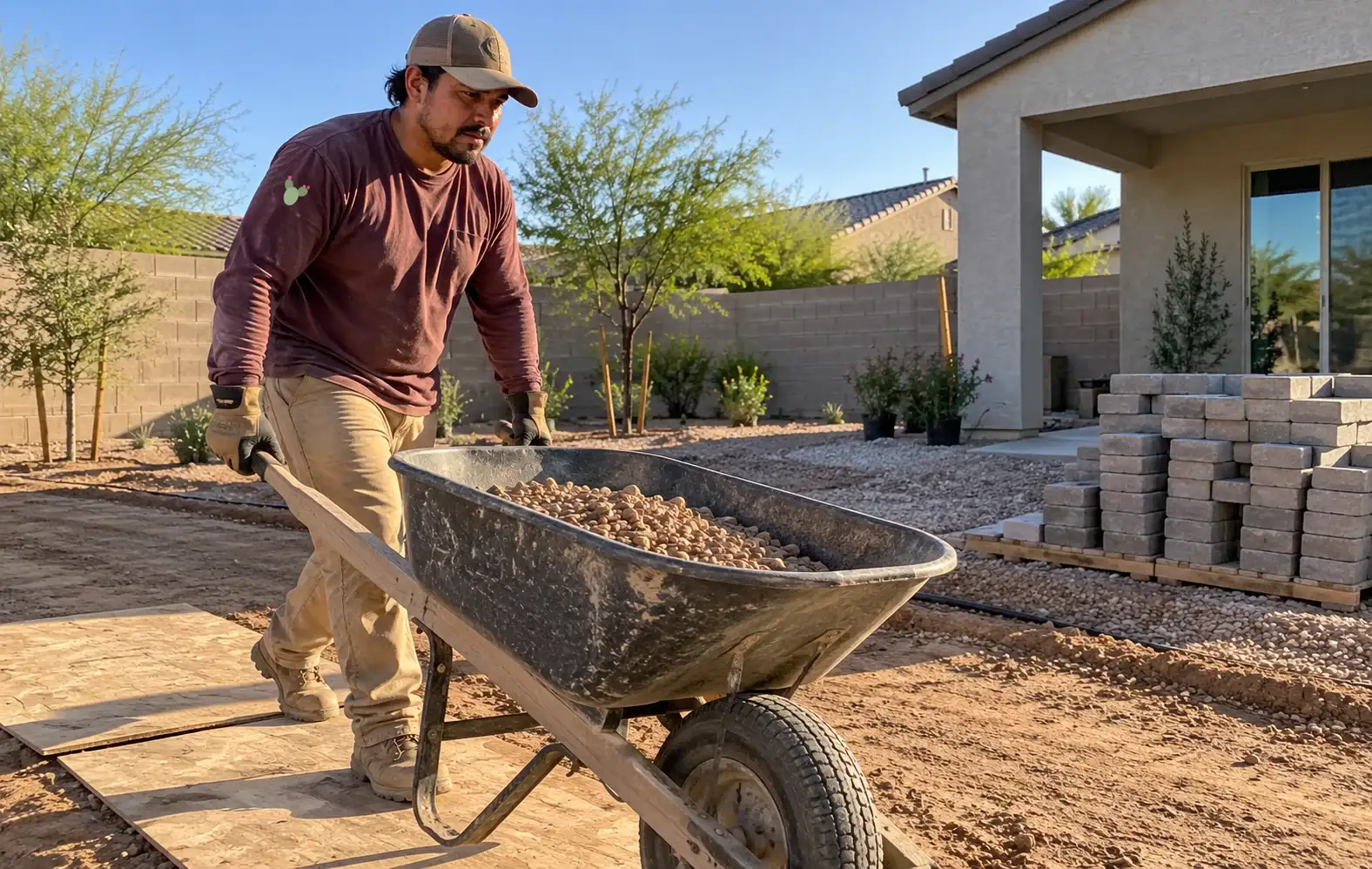
: Landscape installation in Mesa is the work of turning bare dirt or a worn out yard into a finished landscape: grading, irrigation, planting, hardscape and ground cover.Artificial Turf
: Artificial turf installation in Mesa puts a synthetic lawn over a built base, so the base is the part that decides how it looks years later.Pavers and Retaining Walls
: Pavers and retaining walls in Mesa are built on a compacted base, and the base is what keeps them level through monsoon season.Sprinkler Repair
: Sprinkler repair in Mesa comes down to 4 failures: a head that will not pop, a valve that will not close, a line that leaks, and a controller running the wrong schedule.Desert Landscaping
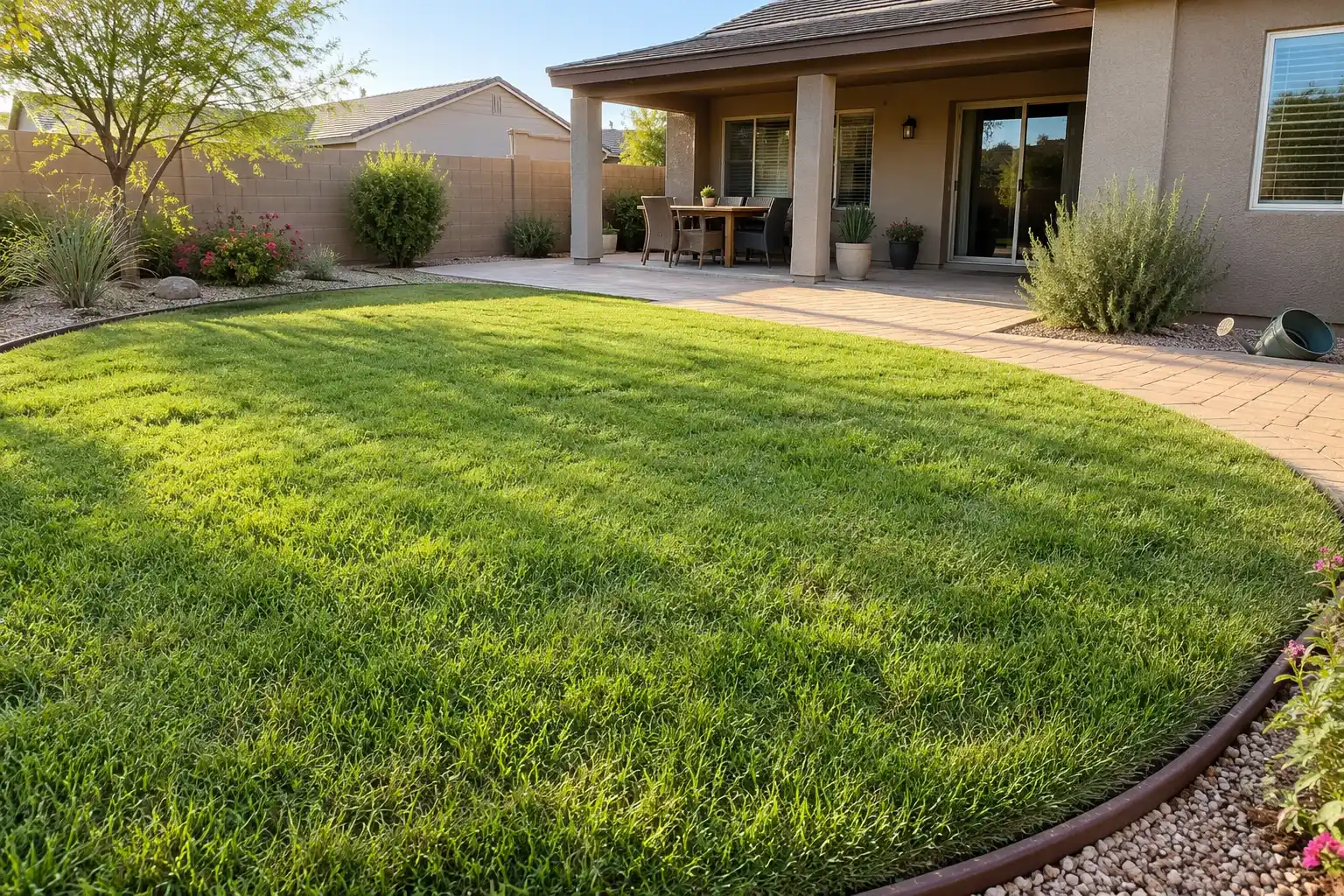
: Desert landscaping in Mesa swaps lawn for gravel, drip line and plants that take zone 9b heat on little water.
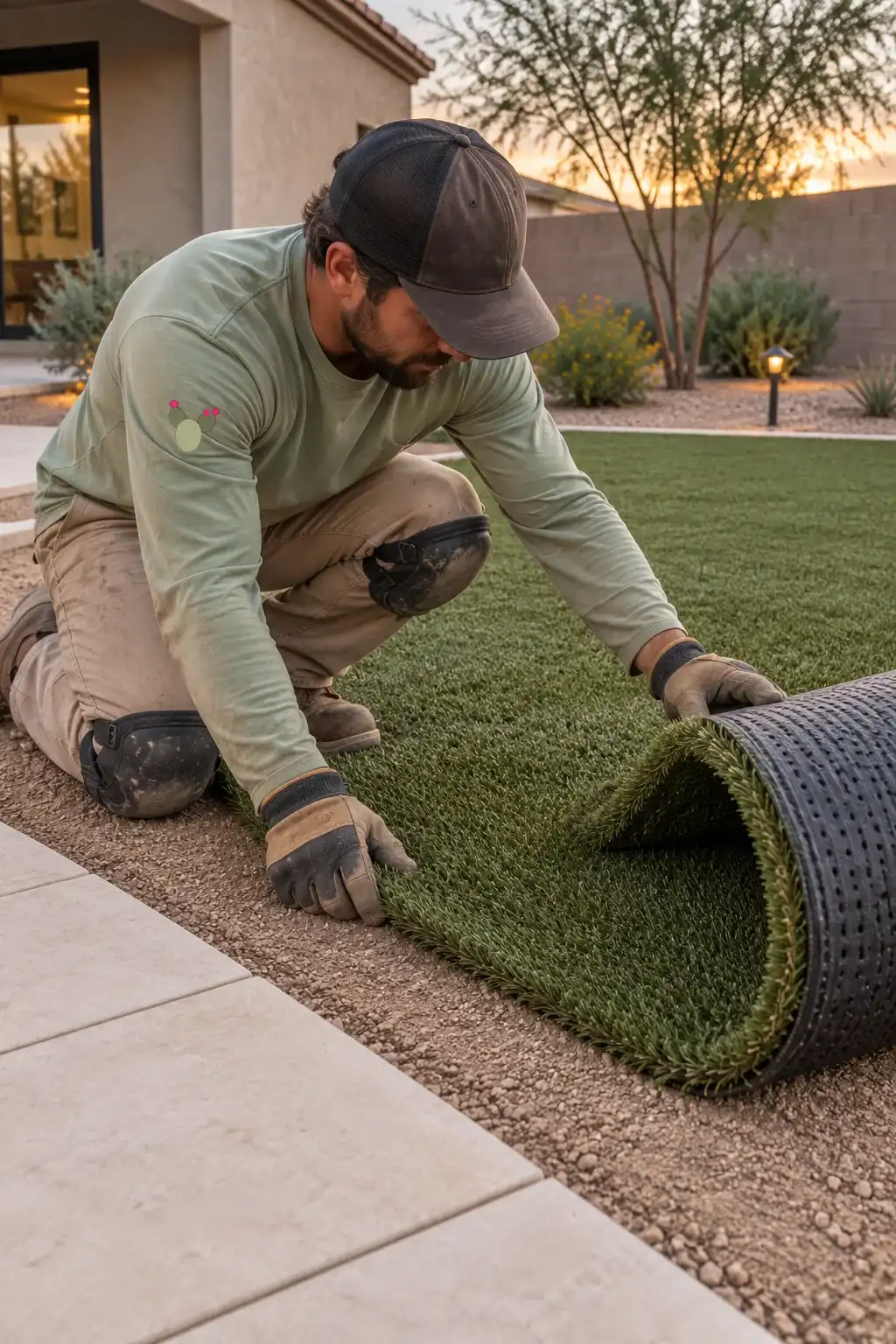
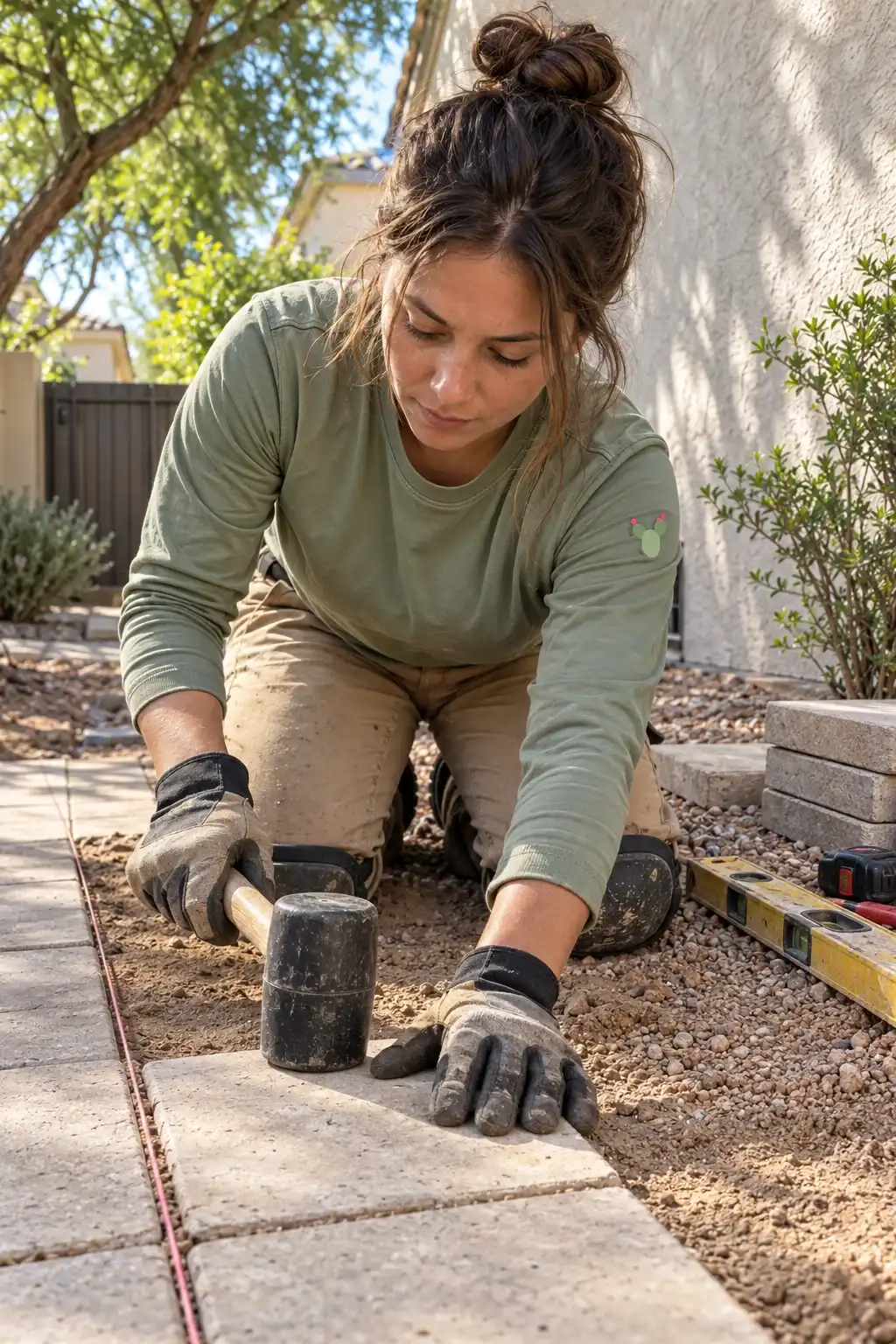
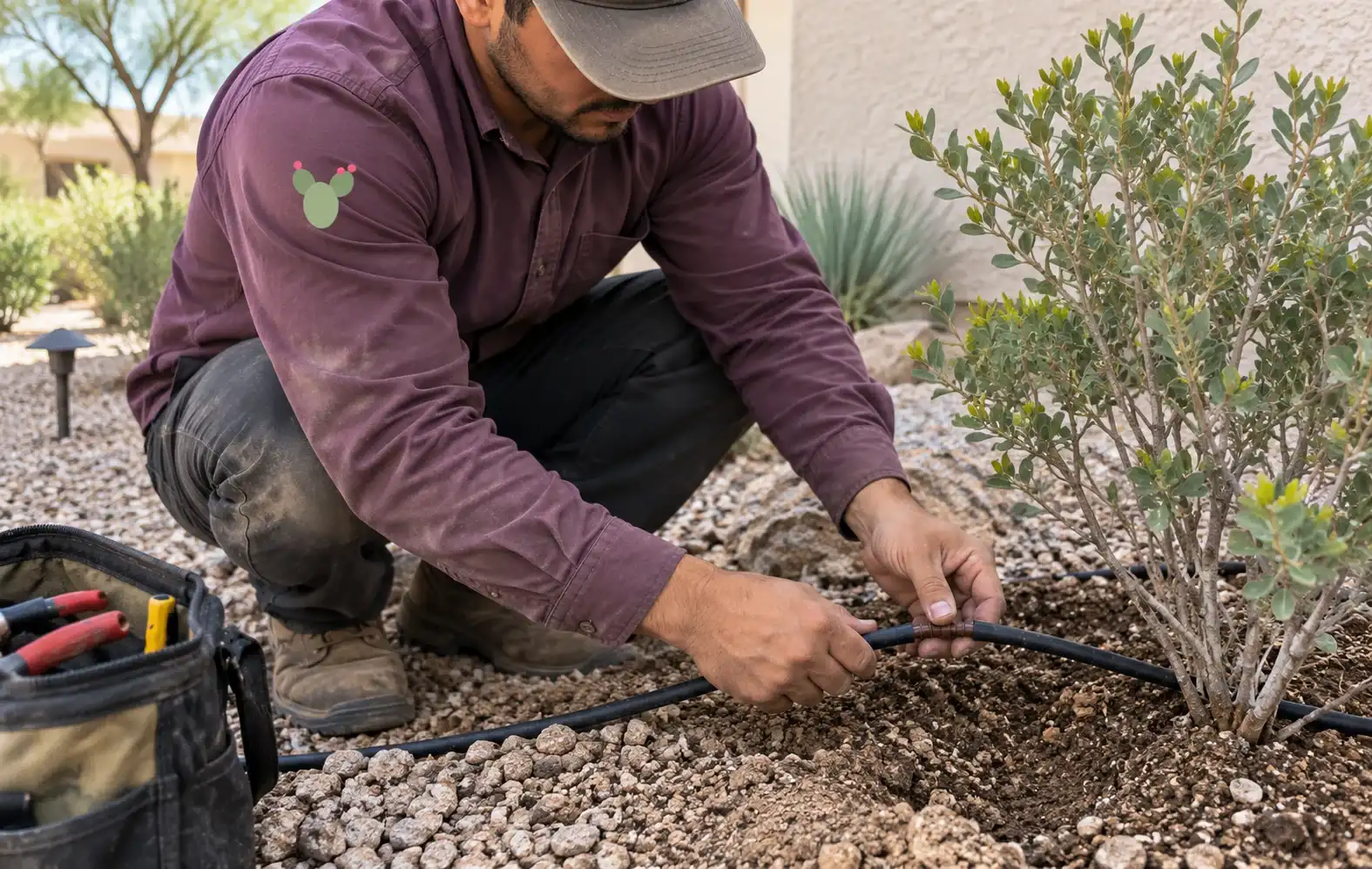
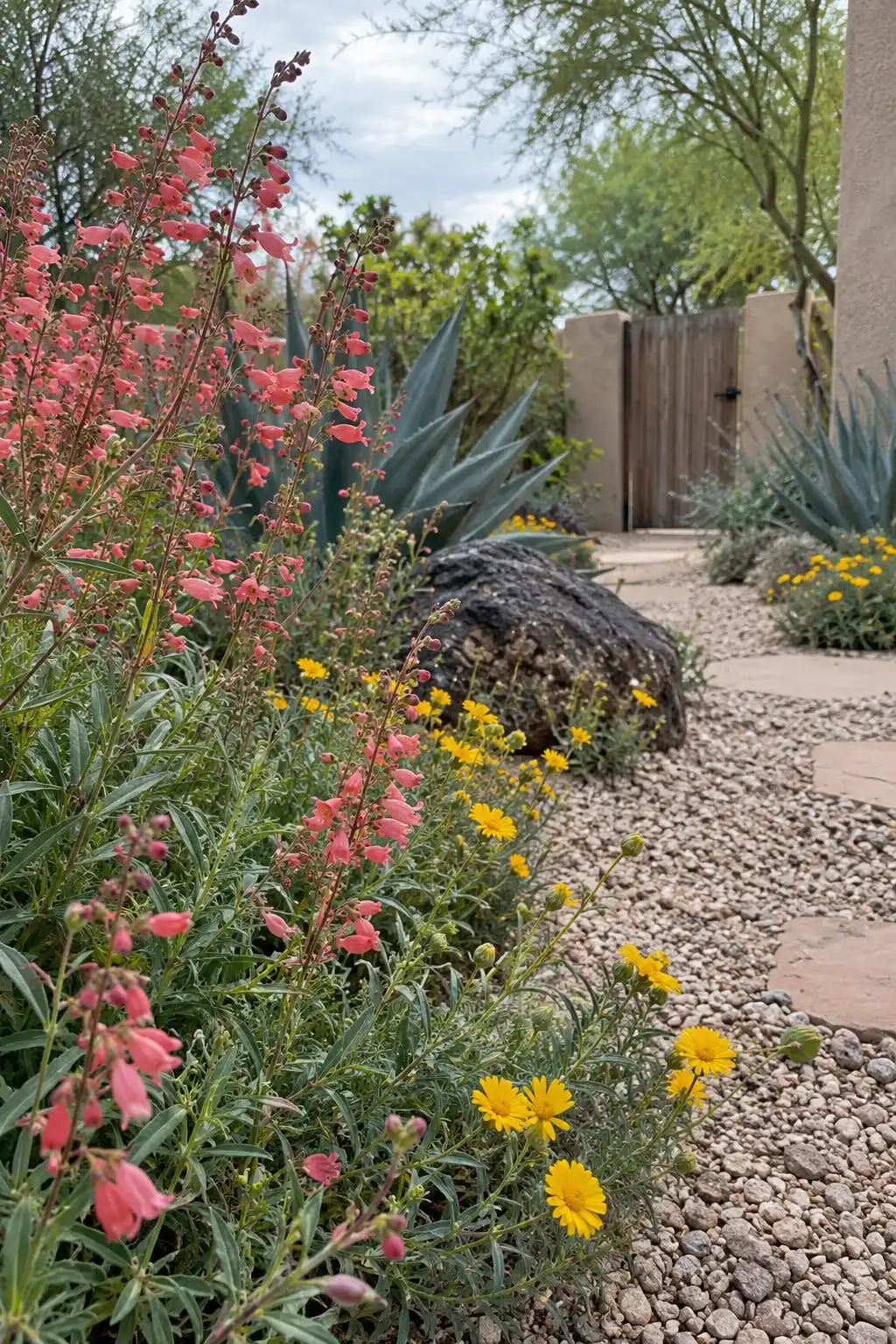
Installation is the largest scope, because a new yard carries grading, irrigation and plant selection in one job. Turf often follows a bigger project, or replaces a lawn that died. Pavers and walls solve a grade or drainage problem and give you a flat place to sit. Sprinkler repair is the smallest scope. Desert conversion is the work the city pays toward through its grass to xeriscape incentive. If you are not sure which one fits, describe the yard when you call or send the form.
Good to know
What are the 3 kinds of Mesa yards?
Mesa yards fall into 3 groups, and each one fails in its own way.
Older west Mesa homes were built when grass was the default. These lots have mature trees, established sprinkler lines and soil that has been worked for decades. The irrigation is often the weak point: old poly pipe, mismatched heads and a controller still running a schedule written for a lawn that is half gone.
Newer east Mesa builds often arrive with a bare backyard and a block wall. There is no shade, the soil is compacted from construction traffic, and the first summer decides whether the yard holds. Those jobs start with grading and irrigation, not with plants.
Foothill lots near the Superstitions bring slope. Water runs fast, caliche sits close to the surface in places, and a wall or a set of steps is often part of the design. The plant list is the same, but the grading and drainage work is larger. Knowing which group a yard falls in makes the first conversation shorter.
Bids and scope
What signs show a yard needs work?
The clearest sign is water running somewhere it should not: against the house, under the wall, or down the sidewalk. That is a grading or irrigation problem, and plants will not fix it.
Other signs: bare dirt where grass used to be, sprinkler heads that spray the block wall, a controller set to run every day in January, trees planted too close to the foundation, gravel that has migrated into the lawn, and pavers that rock when you walk on them. A single dead shrub is normal. A hedge dying from the bottom up can mean too much water, not too little.
Look at the yard after a monsoon storm. Where the water pooled, where the mulch ended up, and which corner washed out tell you more about drainage than any walk through on a dry day. Take 3 photos: the problem area, the controller, and the water meter. Those 3 answer most of the first questions about a yard.
Turf
What does grass to desert conversion involve in Mesa?
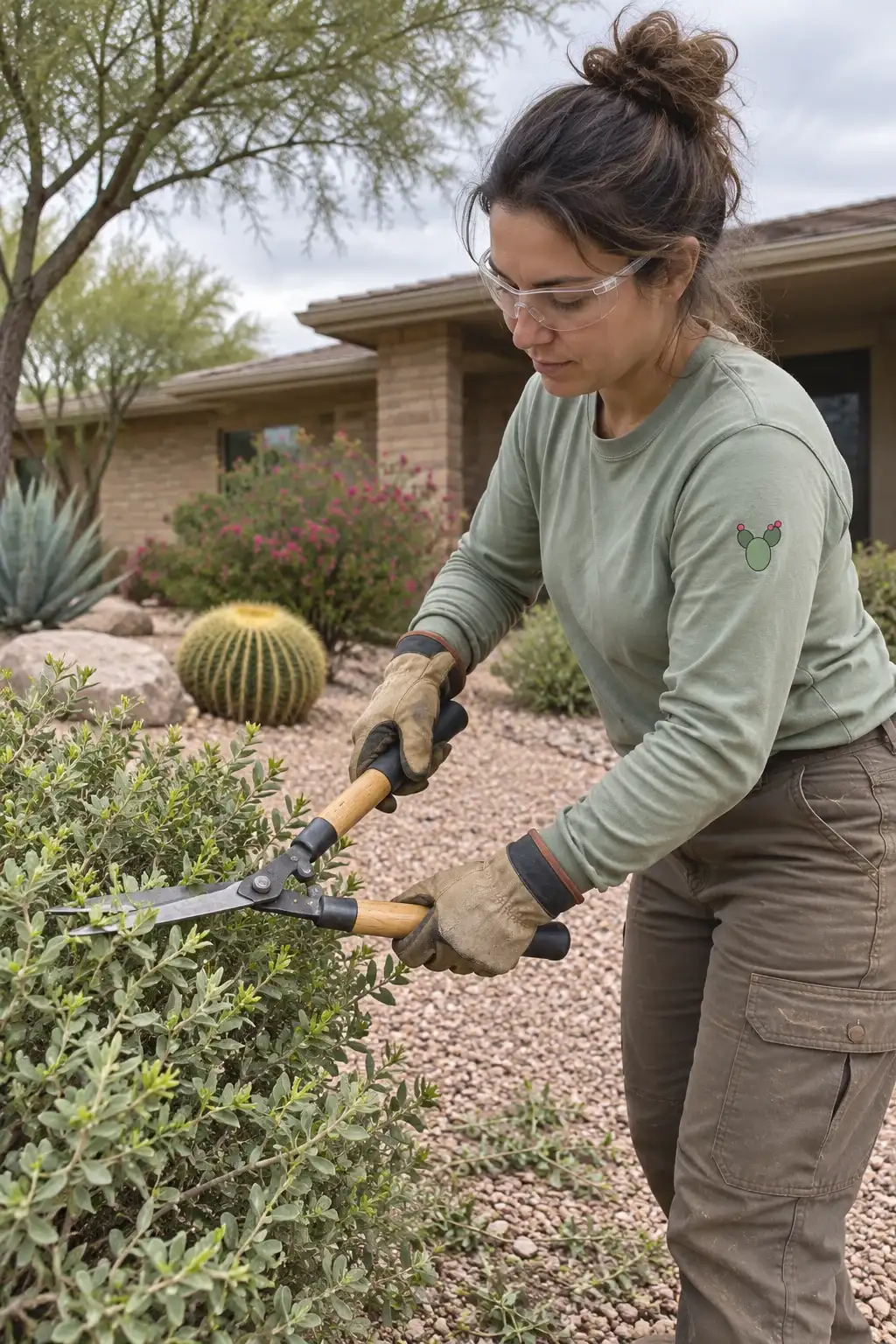
Conversion is a sequence, and in Mesa the first steps are set by the city. If you want the Mesa incentive, the application and a pre-inspection have to happen before any grass comes out. Cut the lawn first and the incentive is gone.
After the pre-inspection, the work runs: kill or strip the grass, cap or reroute the sprinkler lines, grade for drainage, lay drip tubing, then plant and cover the ground with gravel or mulch. The plant list is zone 9b, so it is desert trees, shrubs and groundcover rather than lawn substitutes that drink as much as the grass did.
The last step matters more than people expect. A converted yard is only low water if the irrigation is zoned and scheduled for it. Keep the old lawn schedule on new drip lines and you have spent the money without changing the bill. The controller gets set at the end, with the schedule written on the inside of the valve box.
Costs
Does Mesa pay toward removing grass?
Yes. Mesa's Residential Grass-to-Xeriscape and Tree Bonus incentive (opens in a new tab) pays up to $2,100 to replace grass with low-water-use xeriscape. The rules are specific and they are checked.
The applicant must be the current owner of a single-family home and a Mesa water customer, at least 500 square feet of grass has to come out, and grass watered by wells or flood irrigation does not qualify. The application and a pre-inspection must happen before any grass comes out. The grass has to be healthy, with at least 70 percent coverage, and bare soil or weeds must be under 30 percent of the area. That last rule catches people who let the lawn die first and then apply. There is 1 incentive per property in 3 years. Funding is limited and first come, first served, so the order of your application matters more than the size of your yard.
The city publishes the current form and the inspection steps on its water conservation pages. The job is best planned around the inspection date instead of a build calendar, because moving grass twice costs more than waiting once.
Costs
What is a realistic budget for landscaping a Mesa home?
Most landscaping projects land between $1,248 and $6,068, and the national average is $3,516, per a national cost guide, 2026, from 32,752 projects. A front yard runs $1,500 to $5,000. A full backyard renovation runs $15,000 to $50,000. Per square foot work runs $4.50 to $12, and a 2 person crew bills $50 to $100 per hour.
| Project | Published range |
|---|---|
| Front yard | $1,500 to $5,000 |
| Full backyard | $15,000 to $50,000 |
| Per square foot | $4.50 to $12 |
| 2 person crew, per hour | $50 to $100 |
| New installation | $3,000 to $16,000 |
| Artificial turf | $3,244 to $8,714 |
| Paver patio | $480 to $22,500 |
| Sprinkler repair | $137 to $422 |
Call (747) 243-2089 with the size and the ZIP code to talk through where a project sits against these ranges. These are published national ranges, not a quote. The final price comes after someone sees the yard.
Costs
How much does it cost to landscape a backyard in Arizona?
A full backyard renovation runs $15,000 to $50,000 nationally, per a national cost guide, 2026. A smaller scope lands lower, at $3,000 to $16,000 for a new landscape installation, per a national cost guide, 2026. The spread is wide because a backyard covers everything from gravel and 6 plants to a patio, a wall, turf and a lighting run.
What moves a Mesa backyard toward the top of that range: slope work, a retaining wall, removal of established lawn, and access. A yard behind a wall with a narrow side gate costs more to build than the same square footage with a driveway beside it, because every yard of gravel and every pallet of pavers is carried by hand. Caliche adds time to any digging.
Stage the work if the full number is out of reach. Grading, irrigation and plants first, hardscape second, turf last. Each stage stands on its own and nothing has to be undone. These are published national ranges, not a quote. The final price comes after someone sees the yard.
Costs
Is $100 an hour too much for landscape work?
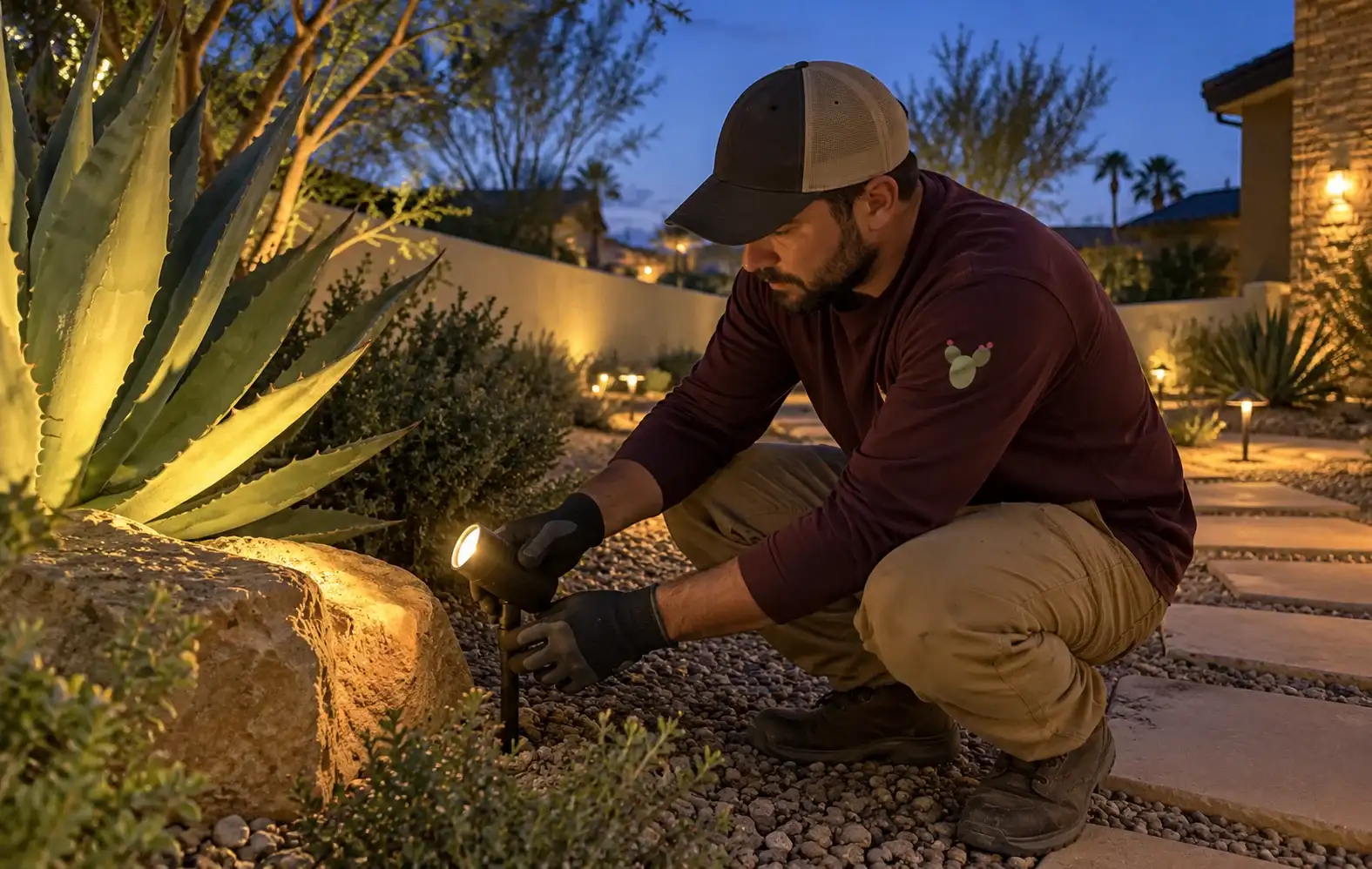
No. A national cost guide's 2026 data puts a 2 person crew at $50 to $100 per hour, so $100 is the top of the published band, not an outlier. What matters is what the hour buys.
2 people, a truck, a plate compactor, a trencher and a trailer of material are not the same hour as 2 people with shovels. What an hourly rate includes varies: dump fees, material delivery, equipment and cleanup can sit inside the rate or on top of it.
The other way to read the number is against the job. An hourly rate says little without the square footage and the day count, because a higher rate with faster production can cost less per square foot than a lower rate that takes longer. These are published national ranges, not a quote. The final price comes after someone sees the yard.
Costs
What does artificial turf cost in Mesa?
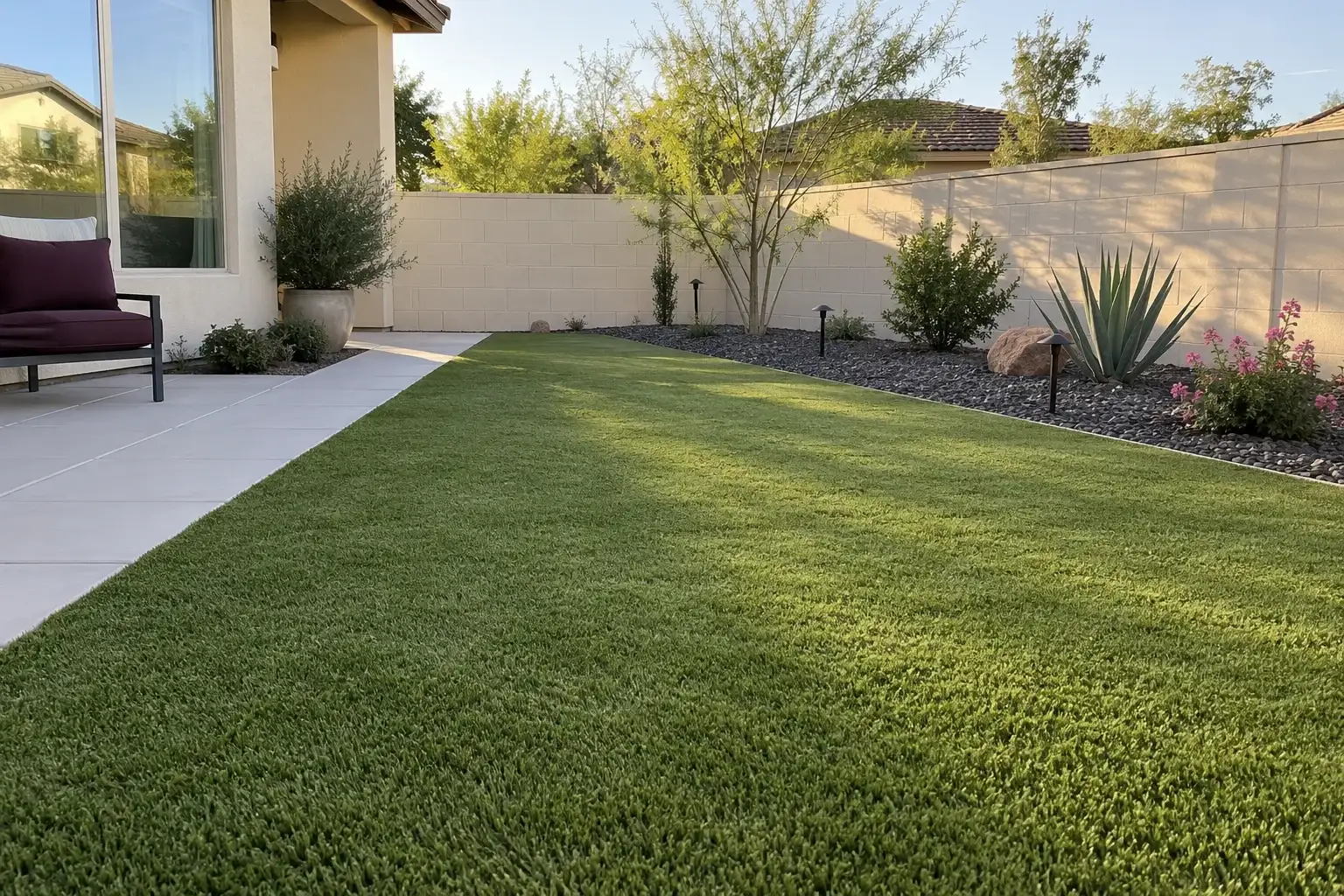
Artificial turf averages $5,783, with most projects between $3,244 and $8,714, per a national cost guide, 2026, from 2,284 projects. Materials alone run $2 to $8 per square foot. Installation is the rest, and in Mesa installation is where the money goes.
Turf needs a compacted base, not dirt. On a Mesa lot that means excavating 3 to 4 inches, hauling the spoil off site, bringing in road base, wetting and compacting it in lifts, then setting the turf and the infill. Caliche and rock slow the excavation, and a yard with poor access adds wheelbarrow time. A pet area can call for a different infill and a steeper fall so waste and rain move off it.
Cheap turf is often a thin base and a loose edge. It can ripple in the first hot summer and lift at the border. These are published national ranges, not a quote. The final price comes after someone sees the yard.
Ground
Do pavers and retaining walls work on Mesa soil?
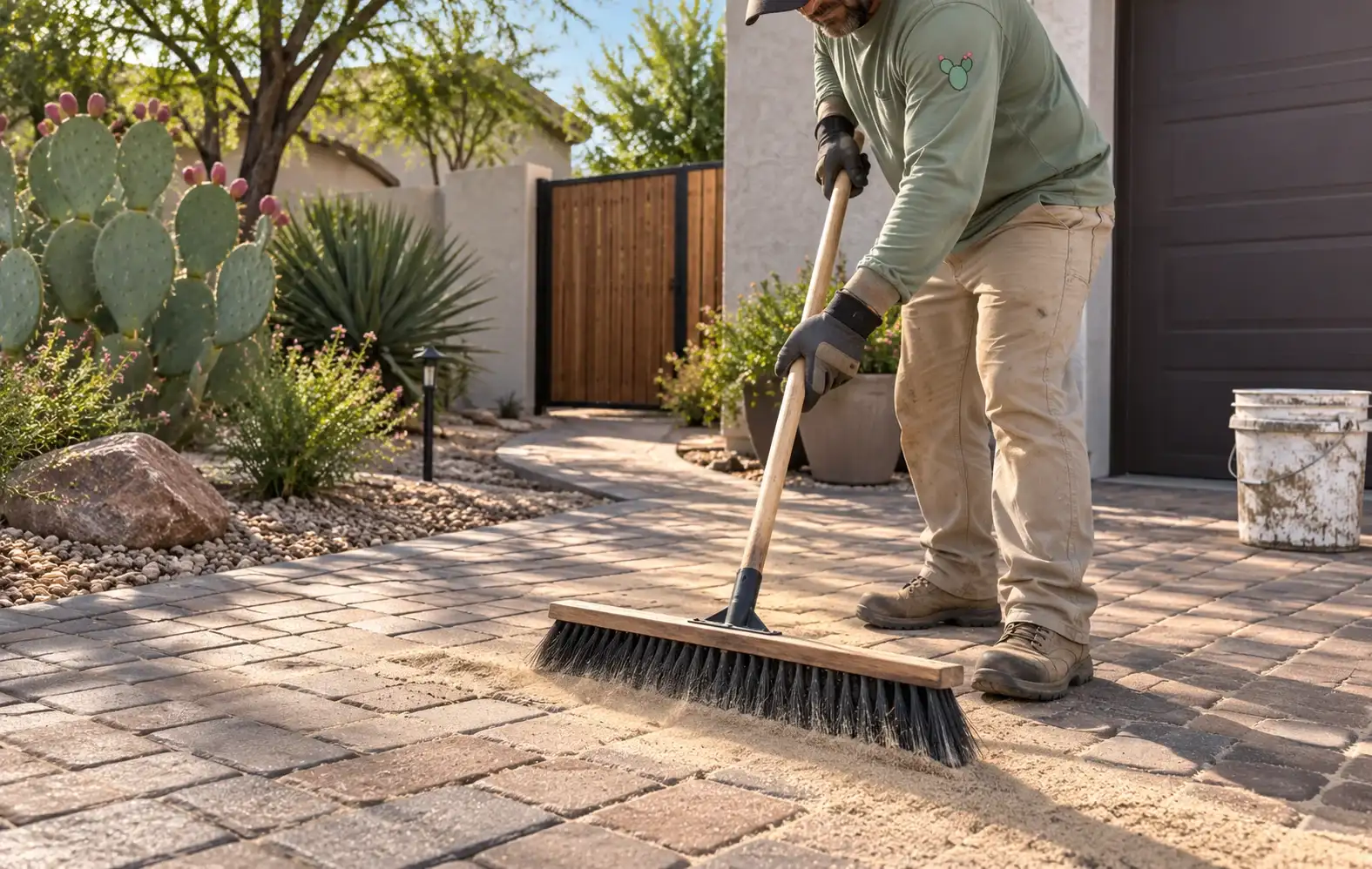
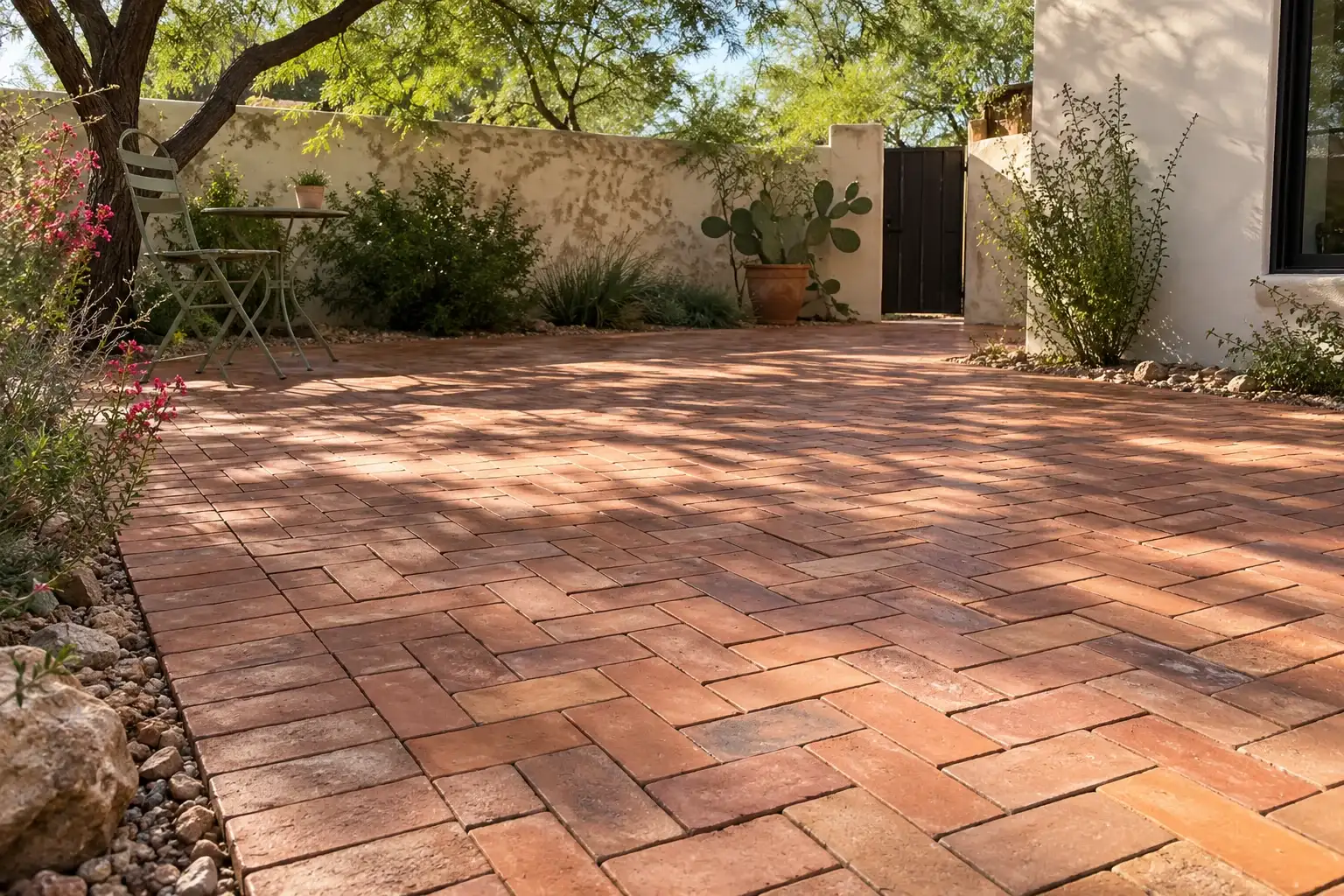
Yes, if the base is built for the soil. Pavers do not sit on dirt. A typical base is a compacted aggregate layer, commonly 4 to 6 inches deep, over geotextile, with the edges restrained. On Mesa ground, that base is the whole job.
A paver patio averages about $3,800 for 280 square feet, with a published range of $480 to $22,500 and $8 to $50 per square foot, per a national cost guide, 2026. The range is that wide because it covers a small walkway and a full outdoor room with a wall.
Retaining walls in Mesa do 2 jobs: hold a slope on a foothill lot, and create a flat usable pad on a lot that falls across the yard. Mesa's residential construction FAQ (opens in a new tab) says retaining walls less than 4 feet tall can be built without a permit if they do not hold back dirt or water. A taller wall, or one that holds back soil, goes to Mesa Permit Services. Drainage behind the wall matters as much as the block. These are published national ranges, not a quote. The final price comes after someone sees the yard.
Water
Why do sprinklers fail in Mesa?
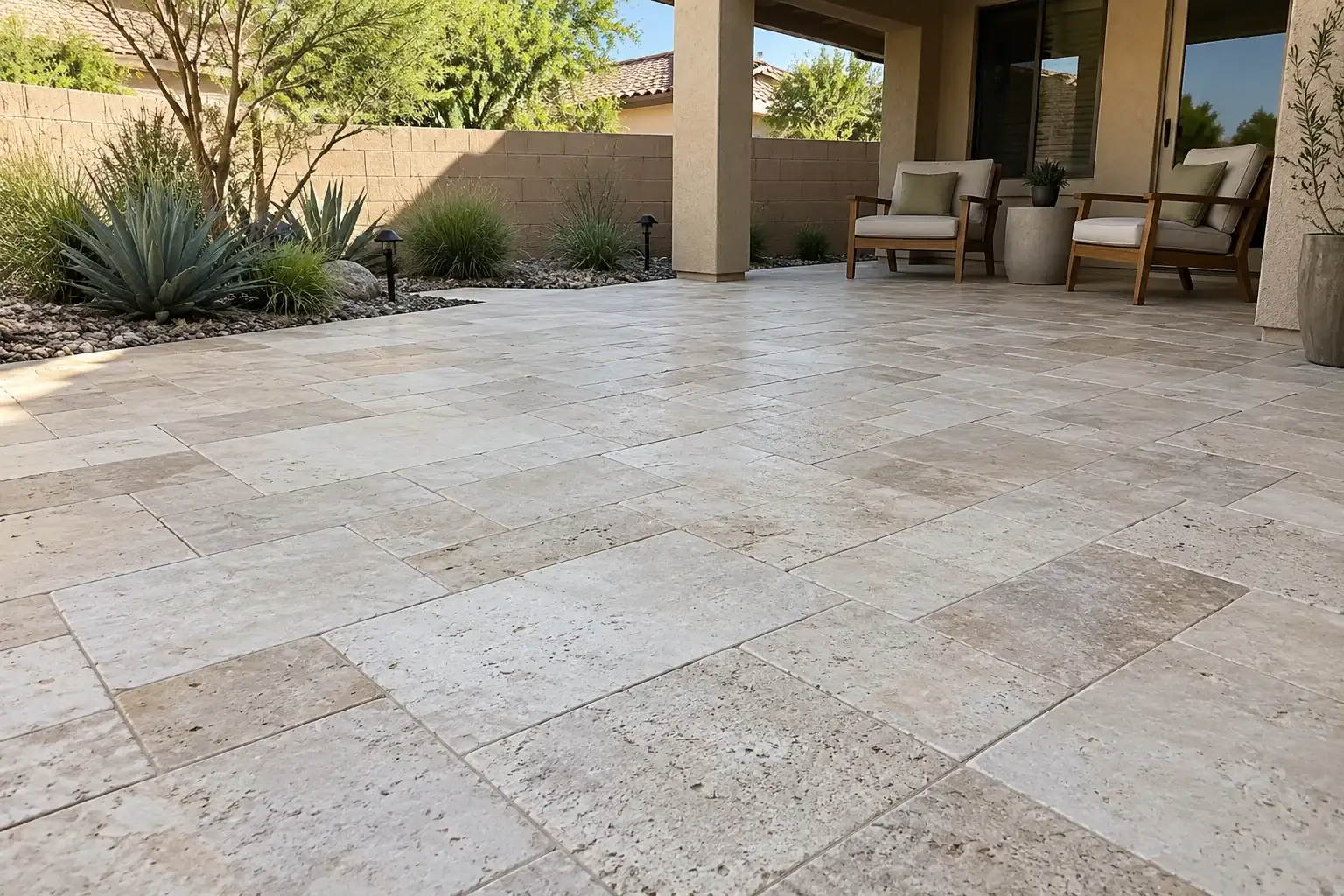
Common failures are the same 4: a cracked head, a stuck valve, a leak at a fitting, and a controller that was never reset. Repairs average $278, with most between $137 and $422, per a national cost guide, 2026, from 36,233 projects.
The Mesa version adds hard water and heat. Mineral scale closes drip emitters and stiffens valve diaphragms. Sun breaks down exposed poly pipe at the riser, which is why the leak is often right at the head. A tree root lifts a line, the fitting pulls apart, and water runs under the gravel where nobody sees it until a plant dies or the bill jumps.
Read the meter once a month with everything off. If the dial moves, there may be a leak. That 1 minute test can catch a leak before it shows up on the bill. These are published national ranges, not a quote. The final price comes after someone sees the yard.
Water
What is flood irrigation and does it affect my yard?
Flood irrigation is water delivered to a property in an open ditch and let into the yard to soak the ground. Mesa's irrigation service serves approximately 300 irrigation customers (opens in a new tab) in a small central area, between Mesa Drive and Country Club, and between 8th Street and 8th Avenue. The city also irrigates several parks and schools.
If you are outside that pocket, irrigation service can still come from another provider: the city's page sends irrigation customers outside its service area to Salt River Project and the Roosevelt Water Conservation District. A yard without irrigation service runs on a pressurized line and a controller.
If you are inside it, water arrives on the city's published irrigation schedule rather than on a controller you set. That changes the design: basins and berms instead of sprinklers, trees that take a soak then a dry stretch, and a plan for where the water enters. It also changes advice on a lawn. Grass watered by flood irrigation is not eligible for the city's grass to xeriscape incentive (opens in a new tab), so conversion math is different there. Confirm the address with the city's irrigation service before you plan.
Planting
What planting zone is Mesa in?
Most of Mesa sits in USDA zone 9b, with an average annual extreme minimum of 25 to 30 F, on the 2023 USDA hardiness map (opens in a new tab), and a few west Mesa ZIP codes such as 85202 and 85210 are in zone 10a, which runs 30 to 35 F. That number is the coldest a normal winter is likely to reach, and it sets which plants survive here.
Zone 9b is warm enough for most desert trees and shrubs and cold enough to rule out the tropicals that grow in zone 10 and 11. It also means cold is not the main problem. Heat is. A plant can be rated for 9b and still fail in July on a west wall with reflected sun and hot gravel.
Read the tag for sun and water, not just the zone number. A plant labeled zone 9 is a starting point, not a promise. The same species can thrive on the north side of a house and scorch on the south side of a block wall 20 feet away.
Climate
Which plants handle Mesa heat?
The plants that work in Mesa come from the Sonoran desert and the Mediterranean, not from a nursery photo taken in California.
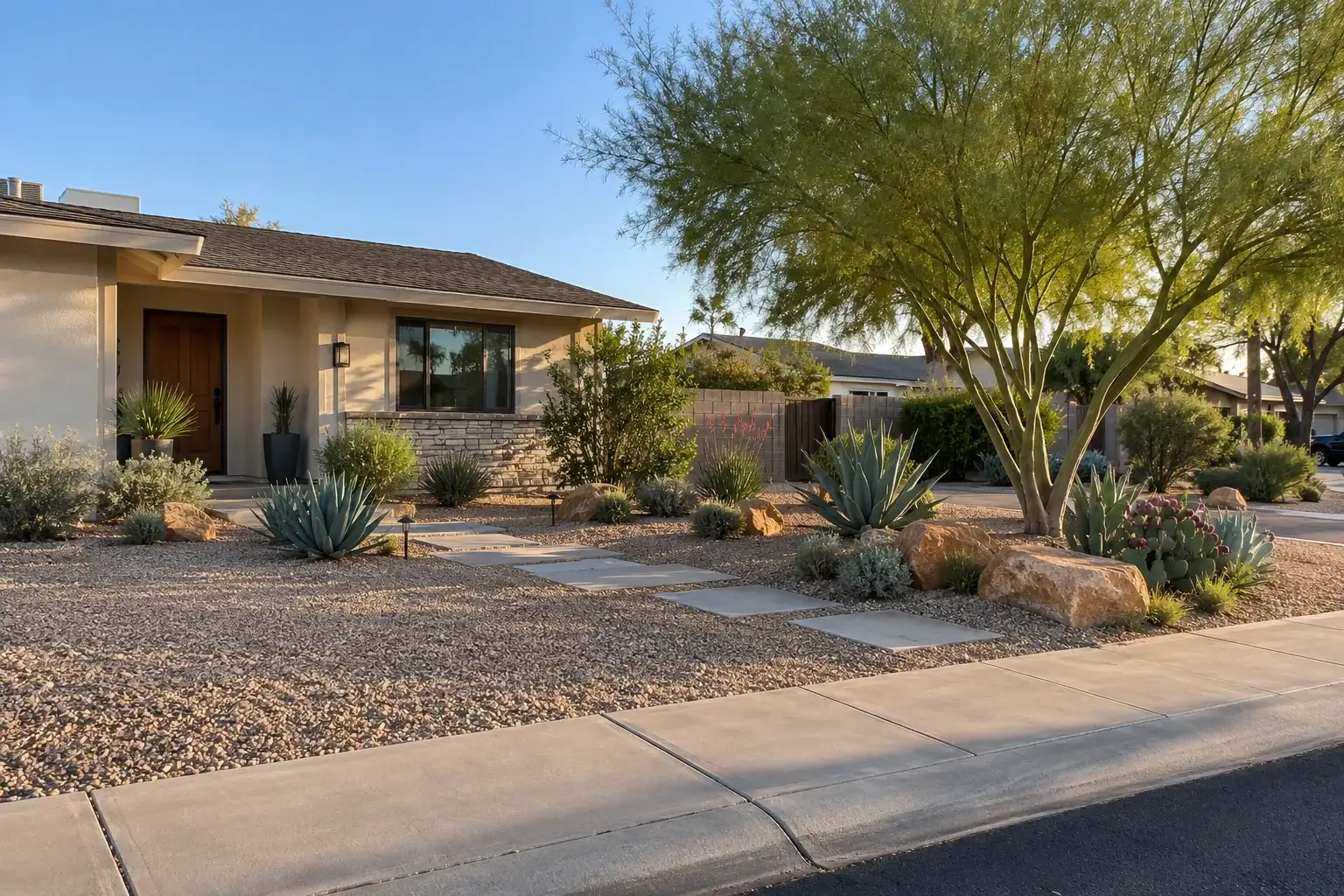
Trees: palo verde, mesquite, desert willow, ironwood. Shrubs: Texas sage, lantana, bougainvillea, oleander, red yucca. Accents: agave, aloe, ocotillo and the various cacti. Groundcover: trailing rosemary, more lantana, and gravel with a few specimens instead of a carpet.
The pattern matters more than the list. Group plants by water need, put the thirstiest ones in the smallest zone, and give every plant room at maturity so you are not pruning a mesquite off the wall in 5 years. West facing walls are the hardest spot, since reflected heat and afternoon sun kill more plants than cold does. Put the toughest species there and save the softer ones for east and north.
None of that list needs lawn watering. That is the point of it.
Ground
What is caliche?
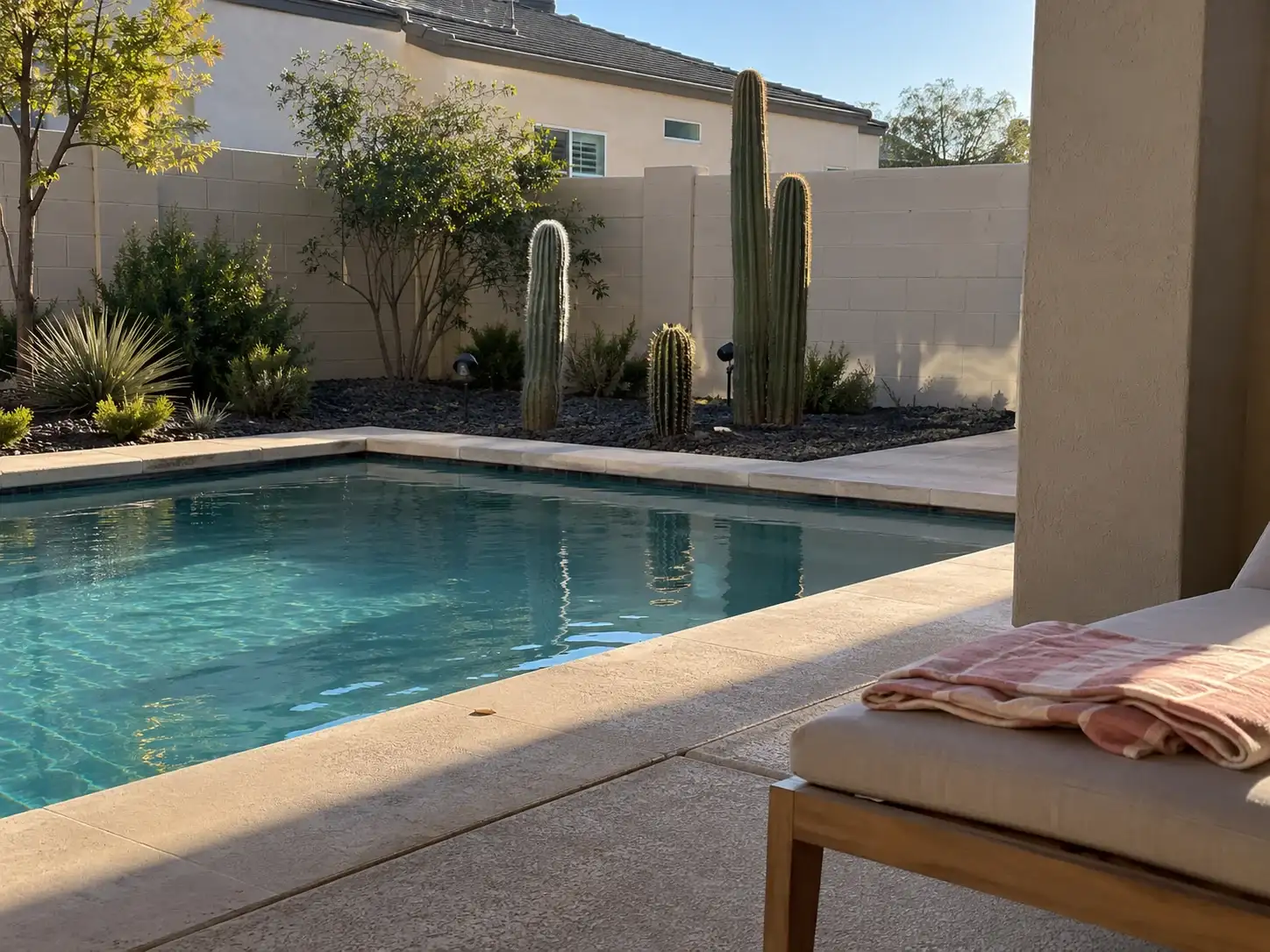
Caliche is a layer of soil cemented by calcium carbonate, and it is a common problem in southern Arizona soils. It looks like pale rock and it behaves like a lid. Water sits on top of it, roots cannot push through it, and a shovel bounces off it.
For a yard, that means 3 things. Drainage has to be designed around it, because a low spot over caliche becomes a pond. Planting holes have to be dug through it, not just into it, or the tree sits in a bucket. And any trench for irrigation or a wall footing takes longer, which is where a budget quietly grows.
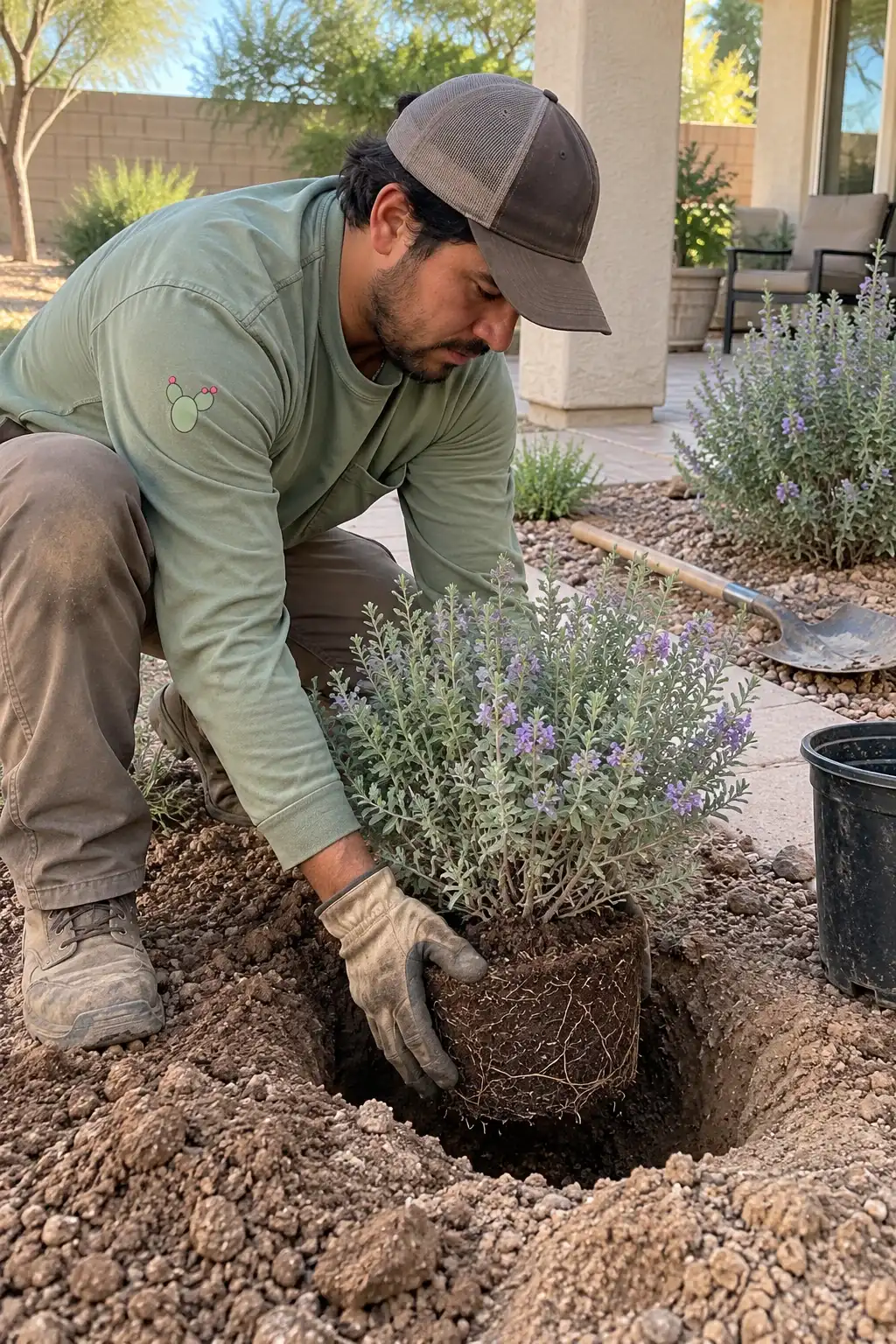
The fix is mechanical: a bar, a breaker, or a machine, plus a plan for where the water goes once it can move. Break the layer apart where you are planting: University of Arizona Cooperative Extension (opens in a new tab) guidance is a hole no deeper than the root ball and up to 3 to 5 times as wide, going completely through the caliche so water can drain. Slope the surface away from the house.
Timeline
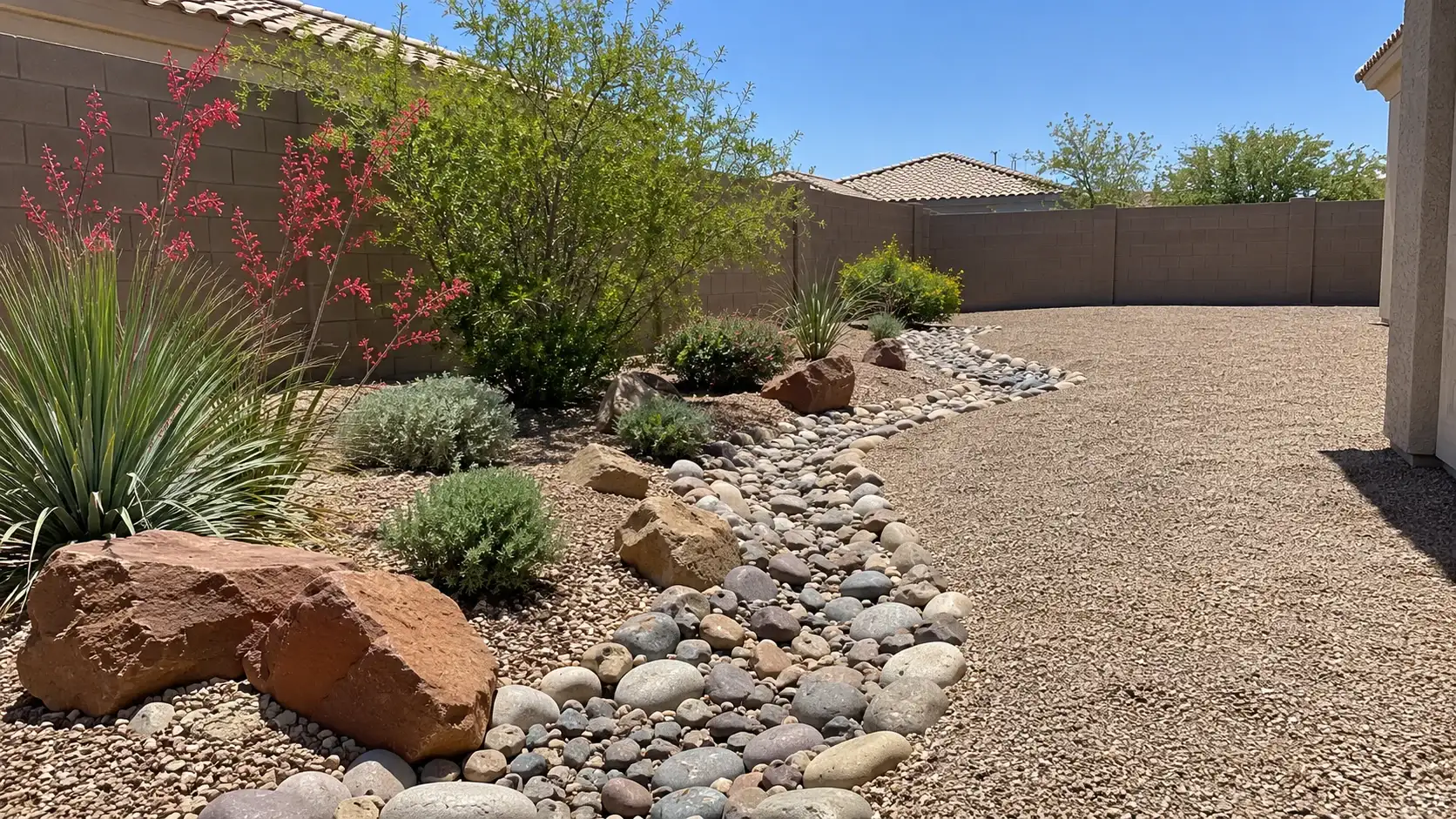
What happens to a Mesa yard in monsoon season?
The monsoon officially runs June 15 to September 30 (opens in a new tab), and July, August and September bring about a third of Mesa's yearly rain, often in short, intense storms. A yard built for a gentle sprinkle will not handle a fast downpour.
What goes wrong: rock and mulch wash off a slope, gravel migrates into turf, basins overflow, gates swell, and water finds the low corner by the wall. If the yard slopes toward the house, that is the expensive one. A wall with no weep holes holds water until it leans.
The fixes are cheap when they are designed in: a swale or shallow channel to move water around the patio, riprap at the outlet, a berm that directs flow away from the slab, and gutters that dump onto splash blocks rather than against the wall. Walk the yard after the first storm of the season, photograph where the water stood, and fix that one spot before the next storm.
Rules
Do I need a permit for a wall or a ramada?
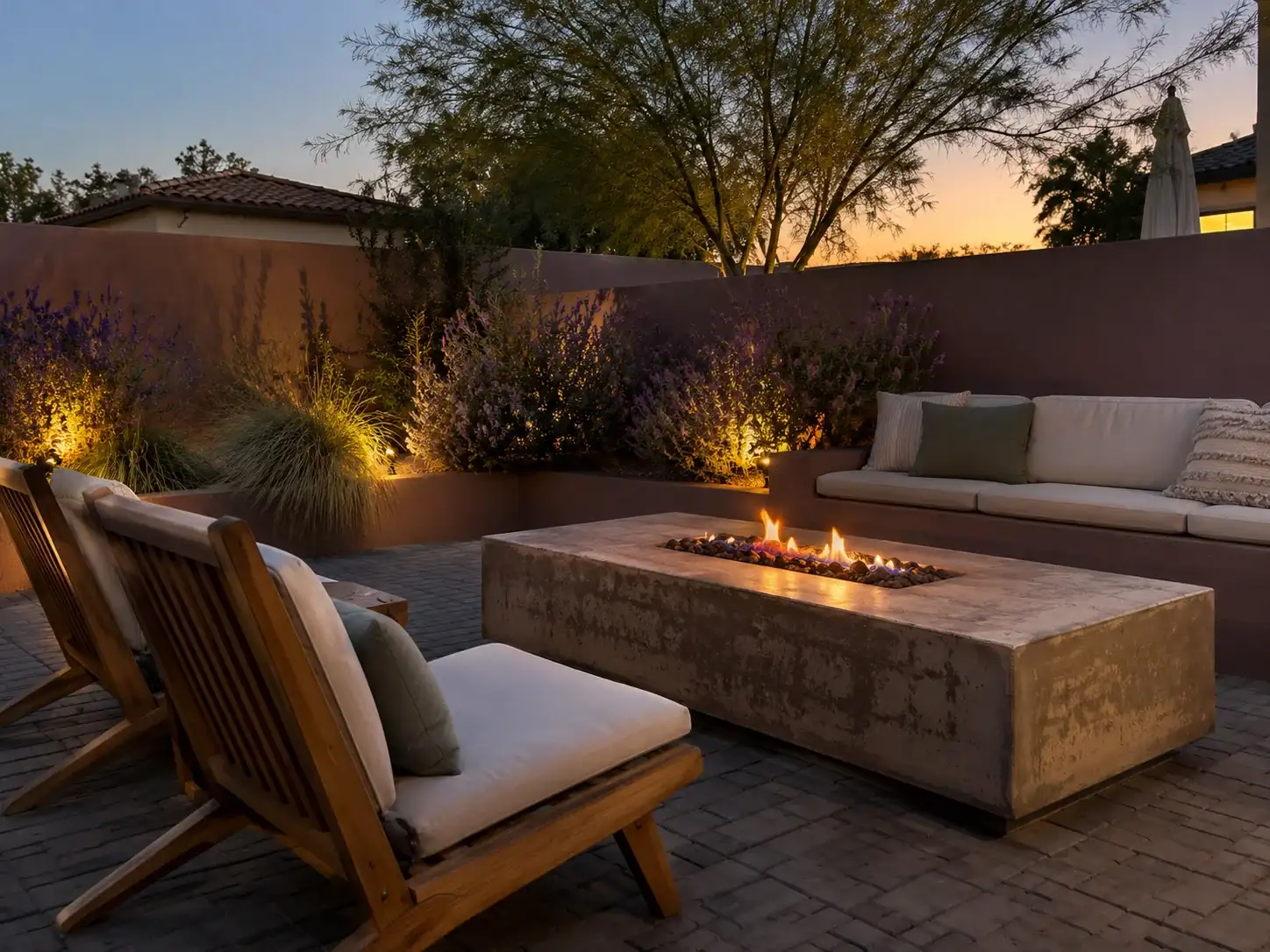
Sometimes. Mesa's residential construction FAQ (opens in a new tab) says fences under 6 feet tall need no construction permit, a detached structure larger than 200 square feet needs approval, and a patio cover may need a construction permit, with height and location requirements applying either way.
What raises the odds: height, a wall close to a property line, a structure over 200 square feet, and anything holding back soil or water. What usually does not: a fence under 6 feet, or a retaining wall under 4 feet that holds nothing back.
Ask before you buy material. Draw the wall on a site plan with the height and the distance to the property line, then call Mesa Planning or Permit Services and describe it. Finding out after the block is delivered is the expensive version, especially on a corner lot where 2 setbacks apply.
Contact
What does the process look like from first call to finished yard?
There are 5 steps from the first call to the finished yard.
First, a call. Describe the yard, the problem and the rough size, and the call sorts out which service it is. Call (747) 243-2089.
Second, a walk through. Someone stands in the yard, looks at the grade, the irrigation, the access and any wall, and measures. That is when a range becomes a number.
Third, a written scope. A price follows the walk through: what is included, what is not, and the payment schedule.
Fourth, the build. Material delivered, demo, grading, irrigation, hardscape, plants, cleanup. Expect the yard to look worse in the middle than it did at the start.
Fifth, a final walk and a controller schedule. The watering plan is written down, because the first 30 days can decide whether the plants make it.
Service area
Which areas around Mesa do you cover?
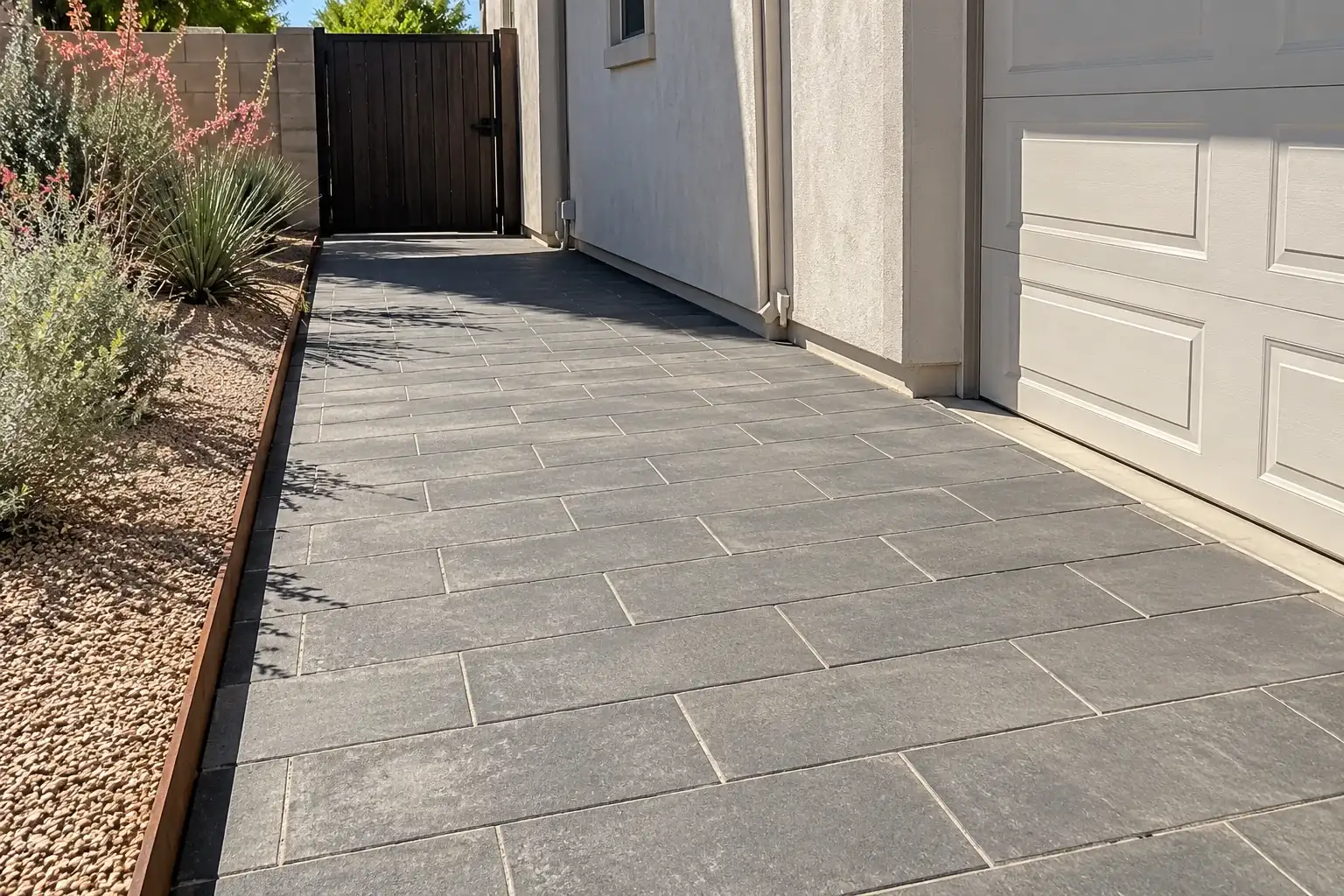
We serve Mesa and the towns around it. Inside Mesa that includes east Mesa, Las Sendas, Eastmark and Dobson Ranch. Around the edges are Gilbert, Apache Junction, Queen Creek, Tempe, Chandler, Scottsdale, San Tan Valley, Gold Canyon and Fountain Hills.
The job does not change much across that map, but the rules do. Water rules are set by the city or utility that serves the property, and they differ from Mesa's, so confirm the current schedule before changing a controller. HOA review is another variable, since some communities want a submittal before any hardscape or plant goes in.
If your town is not on the list, call (747) 243-2089 and ask.
7 questions
Questions people ask
Still have a question? Call (747) 243-2089 and describe the yard.
Can a yard in a Mesa HOA community be landscaped?
Yes, with HOA review as an extra step. Mesa also runs a separate water program for HOAs and commercial properties, where the HOA board president listed with the Arizona Corporation Commission has to be the signer, and funding is limited (City of Mesa, water management for HOAs (opens in a new tab)). Expect a design submittal before work starts. The community guidelines are read before pricing, because an approved plant list or a paver color rule changes the material order.
Can I keep some of my grass?
Yes. A smaller lawn with desert planting around it is a common Mesa design, and it keeps a play area without the full water bill. Keep the turf where it gets used and where it is flat. Converting the rest can be the cheaper half of the job, and the city incentive can still apply to the part you remove, as long as at least 500 square feet of healthy grass comes out.
When is the best time of year to landscape in Mesa?
Fall is the easiest window. Soil is still warm, air is cooler, and new plants have months to root before their first summer. Spring works too, if you accept that the first summer will need more water and more watching. Summer installs are possible but hard on fresh plants and on anyone working outside. Winter is fine for hardscape and grading.
Who fills out the Mesa rebate application?
The homeowner does. The application comes from the owner, who must be the Mesa water customer, and the pre-inspection has to happen before any grass comes out. The removal is then planned around the inspection date, the grass stays intact until the city approves, and the build follows the xeriscape standard the program expects. Applying is the owner's step, and it is worth doing early.
How do I get a price for my yard?
Call (747) 243-2089 or send the contact form with the ZIP code, the project and a rough size. A photo helps. A few questions follow, then a walk through is set. The written scope with a price that follows is where the range becomes a number, because grade, access and caliche change the labor more than square footage does.
Does artificial turf get too hot in Mesa?
It gets hot, and it stays hotter than real grass through the afternoon. Light colored turf runs cooler than dark green, and shade over the surface helps. For a pet area or a play area, plan shade and check the surface with a bare foot before you commit. Real grass is cooler, and it costs more water.
What can I plant in July?
Very little. July is the worst month to put a new plant in the ground here, because heat and root disturbance hit at the same time. If you must plant, use shade cloth, water by hand for the first weeks, and pick the smallest pot size that will do the job. Otherwise wait for September, when the monsoon rain and cooler nights help.