Service 04 of 05 · Mesa, AZ
Sprinkler Repair in Mesa, AZ
Sprinkler repair in Mesa comes down to 4 failures: a head that will not pop, a valve that will not close, a line that leaks, and a controller running the wrong schedule. The wet spot or the dry zone is traced back to the part that failed, the part is fixed, and the timer is reset for a desert yard.
Last updated
01Water
What does sprinkler repair in Mesa cover?
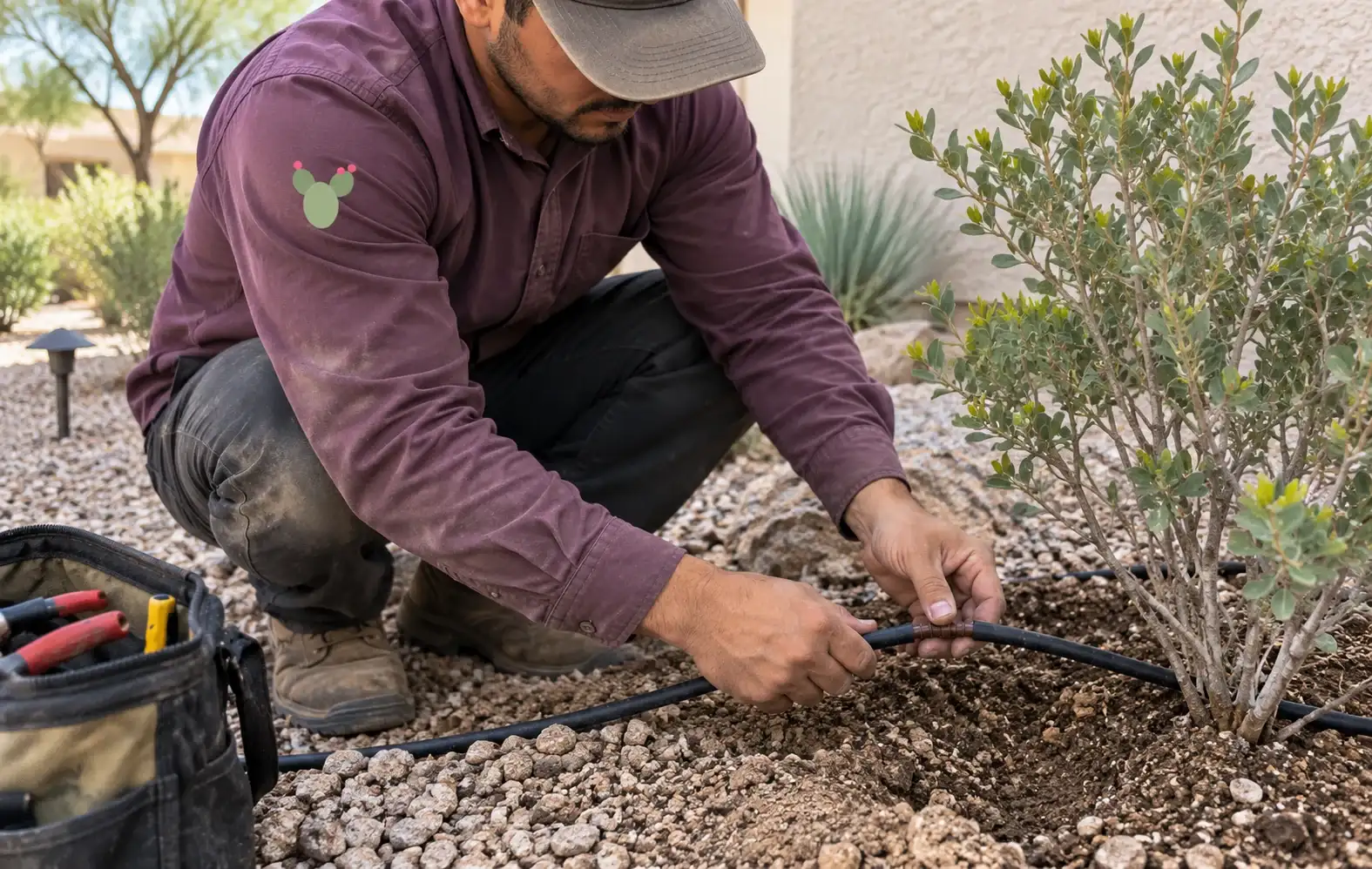
Repairs cover spray heads, rotors, drip emitters, valves, lateral lines, mainline breaks and the controller that runs them. A repair often starts with 1 zone that stays dry or 1 patch that stays wet, and the job is to trace that symptom back to the part that failed. Heads get replaced when the riser cracks or the nozzle clogs with mineral grit. Valves get rebuilt when the diaphragm stops sealing. Poly line gets cut and coupled where a root or a shovel found it. Pressure also gets tested at the hose bib and at the last head on the zone, because a system that dribbles at the far end is not fixed by swapping nozzles. Drip tubing, emitters and filters fall under the same visit.
02Costs
What does sprinkler repair cost in Mesa?
Published national data puts sprinkler repair at an average of $278, with most repairs landing between $137 and $422, according to a national cost guide, 2026, based on 36,233 projects. A single head swap sits at or below the bottom of that band, and pipe leaks, controller repair and valve work cost more. The number that moves the price most is access: a break in open gravel is quick, while a break under pavers or a block wall means cutting, lifting and resetting. Drip repairs can be priced by the run rather than by the head, because the filter and the pressure regulator are common failure points. A written diagnosis before digging starts keeps the scope clear. These are published national ranges, not a quote. The final price comes after someone sees the yard.
03Planning
How does a repair visit run from start to finish?
A visit starts at the controller, with each zone run by hand to see what moves and what does not. Then the yard gets walked, every head on the bad zone is checked, and the valve box is opened to watch the solenoid and the diaphragm. Once the failed part is known, the water is shut off, the part is dug out and replaced, and the zone is pressure tested before backfilling. The last step is the schedule: run times are set, the rain sensor is checked if there is one, and the owner is shown which zone does what. A single zone repair is usually shorter than a mainline break under hardscape, a valve manifold rebuild or a controller swap with new wiring, and the scope should say which one it is before work starts.
04Water
Why do sprinkler systems fail in Mesa?
Heat and mineral content do most of the damage. Mesa water is hard, ranging from 12 to 22 grains per gallon depending on the source (City of Mesa, water quality (opens in a new tab)), and dissolved minerals can collect in nozzles and emitters until a head sprays a fan instead of a pattern. Sun can make plastic risers and exposed poly line above gravel brittle. Caliche is the other half of the problem: that cemented layer restricts water movement (UA Extension, managing caliche (opens in a new tab)), so a head running on a normal schedule can flood the surface while the root zone below stays dry. Add mower strikes, foot traffic and tree roots pinching lateral line, and a system that ran fine in spring starts to show dry corners by June. Pressure that runs too high makes it worse, because misting heads lose water to wind before it lands.
05Water
What causes a stuck valve?
A valve sticks open when grit, roots or a worn diaphragm keeps the seal from closing. The symptom is a zone that keeps running after the controller has moved on, or several heads that stay wet for hours. Water may also weep past the valve body into the yard with no zone calling for it. Turn the water off at the backflow or the meter before you dig, then open the valve box and check 3 things: the solenoid, the diaphragm and the wire connections. A solenoid that has failed electrically will not open at all, while one that has failed mechanically can stay open. Rebuilding the top end of the valve is usually faster than replacing the body, and it keeps the existing fittings and pipe.
06Water
How do I find a leak before it soaks the yard?
Look for a strip of grass that stays green when the rest goes dry, a soft spot that sinks underfoot, or water bubbling through gravel with no head running. A mainline leak often shows as a hissing sound at the backflow when every zone is off. The meter test is the simple one: shut every zone and every hose bib, then watch the meter dial for movement. If it moves, water is escaping somewhere. The mainline gets isolated from the laterals, pressure tested in sections, and dug only where the test points. A leak left running for weeks can hollow out the soil under a slab or a walkway, and that repair costs more than the pipe did. Finding the leak first protects the patio, the lawn and the gas line, and it turns a guessing game into 1 hole instead of 4.
07Water
What is different about flood irrigation in central Mesa?
Mesa runs a city irrigation service for approximately 300 customers in a small central area, between Mesa Drive and Country Club, and 8th Street and 8th Avenue (City of Mesa (opens in a new tab)). The city also irrigates several parks and schools. If a property sits inside that boundary, the yard may be watered on the city's weekly irrigation schedule rather than on demand from a pressurized meter. That can change repair work, because how the water arrives matters before parts are priced.
08Timeline
How do I set a controller schedule for a Mesa yard?
Set the controller for the season, not for the year, and use cycle and soak rather than 1 long run. Caliche takes water slowly, so several short starts with a gap between them can put more water in the root zone than a single long pass that runs off into the street. Run established desert plants on a separate drip zone with its own schedule, because they need far less than a lawn. Mesa publishes conservation guidance through its Environmental and Sustainability Department (City of Mesa (opens in a new tab)), and that is the page to check before changing times. After any repair, recheck the schedule: a zone that was running long to cover a broken head will overwater once the head works again.
09Planning
What should be ready before the visit?
Know which zone is misbehaving and what it does when you run it by hand. Have the controller model and the valve box location ready, clear the lid of gravel, and open the gate. If you have a plot plan or a zone map from the builder, send it. If not, a phone photo of the valve box and the controller panel saves time. Mention dogs, pool equipment and anything buried where the digging will happen.
10Good to know
What maintenance keeps a system working after a repair?
Walk the zones once a month while the system runs and look at every head. A head that sprays sideways, geysers or sits below grade is wasting water and eroding soil. Clean the filter on the drip zone, because grit from the main collects there first. Replace nozzles in sets, since mismatched nozzles throw off the pressure balance across a zone. Before winter, cut run times back and check the backflow for weeping. After the last cold snap, run each zone by hand and look for cracked risers. Keep the valve box lid on and the box clear of gravel. Write the controller model and the zone order inside the cabinet door, because the next repair starts there. A small head problem that runs unchecked for a season can turn into a larger repair.
11Costs
Can the repair cost be staged?
Yes, and it often should be. Fix the failure that is wasting water first, because a stuck valve or a mainline break costs money every day it runs. Then group the efficiency work into a second visit, such as replacing a set of worn heads, rebuilding a second valve, or swapping a spray zone to drip. If the controller is old and the wiring is sound, a controller swap can often wait. Staging works best when the diagnosis covers the whole system in 1 pass, so the second visit is planned rather than reactive. A written list of findings with the parts listed makes it easier to decide what happens now and what happens next quarter. Call (747) 243-2089 if you want the diagnosis walked through first.
12Costs
What is the cheaper version of a full system replacement?
Repair what failed and keep the pipe that still holds pressure. A full replacement is rarely needed when the mainline tests clean and the valves are serviceable. The cheaper path is usually 3 moves: rebuild valve top ends instead of replacing bodies, replace heads and nozzles on the zones that matter, and convert 1 or 2 spray zones to drip for shrubs. Cap or merge zones that water nothing but gravel. If the only thing missing is a modern timer, a controller swap costs far less than new wire and new valves. A full replacement makes more sense when the mainline fails a pressure test in several places. Get the pressure test result first, because a system losing pressure at the mainline will waste any money spent on new heads.
13Service area
Which Mesa areas do you cover?
We serve Mesa and the towns around it. In Mesa that includes east Mesa, west Mesa, Dobson Ranch, Las Sendas and Eastmark, plus the central blocks inside the city irrigation service area between Mesa Drive and Country Club. Coverage also includes Apache Junction, Gilbert, Queen Creek, Tempe, Chandler, Scottsdale, San Tan Valley, Gold Canyon, Fountain Hills and Phoenix. Older yards can have original valve manifolds and mixed spray and drip zones, and newer builds can have 1 controller running everything on a builder schedule. Send the ZIP code and someone from our team will call you back about coverage.
145 questions
Questions people ask
Still have a question? Call (747) 243-2089 and describe the yard.
01How much does a sprinkler repair cost?
Published national data puts the average at $278, with most repairs between $137 and $422. A single head or a clogged nozzle sits at the low end, and a break under pavers adds cutting and resetting. The final price comes after someone sees the yard.
02Can a sprinkler system be repaired in summer?
Yes. The work is hot and the ground is hard, but a failed valve or a broken mainline should not wait for October. Summer repairs tend to start early, with the water shut at the meter before digging and a pressure test before backfilling. Shade and water access are worth sorting out before a July visit.
03Why does 1 zone stay wet when the controller is off?
That points to a valve that is not sealing. Grit on the diaphragm, a worn seat or a solenoid stuck open will let water pass into the zone with no call from the controller. Shut the water off at the meter and have the valve rebuilt before the soil under the heads turns to mud.
04Does drip irrigation need different repairs than spray heads?
Yes. Drip fails at the filter, the pressure regulator, the emitters and the tubing connections, not at pop up risers. Clogged emitters show as dry plants in a wet bed. A drip zone also runs at lower pressure, so a repair that ignores the regulator will keep burning through emitters.
05Will a repair change my watering schedule?
Yes. A zone that was running long to cover a broken head will overwater once the head works again. Run times get reset by season and long runs get split into cycle and soak passes. Check Mesa's current conservation guidance before you change the controller, then adjust from there.
15Keep reading